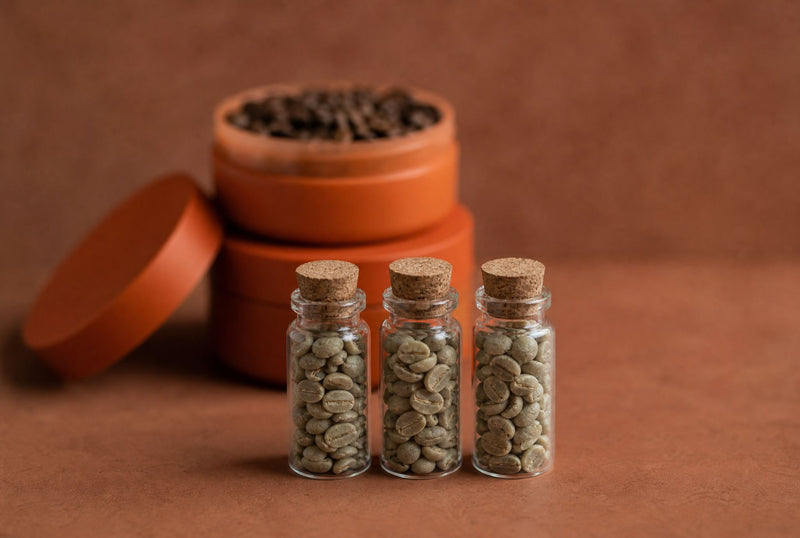
Mould in coffee is a moisture problem, not a farming problem. Certain moulds settle on the fruit while it dries, or later in humid stores and shipping containers, and a few of them leave mycotoxins behind. Careful drying and dry storage prevent it. Testing the green bean is the only way to confirm it.
Coffee is an agricultural product that spends months in warm, wet places. Worth being unsentimental about that.
Where mould gets in
Almost always during drying, and after it. A ripe coffee cherry is around 60 per cent water. Getting the seed down to roughly 10 to 12 per cent takes days on a patio or a raised bed, turned by hand. If rain interrupts, or the beans are heaped too deep, the surface stays damp long enough for common moulds of the Aspergillus and Penicillium families to establish. Those are the moulds that can produce ochratoxin A and the aflatoxins.
The second window is storage and transit. Jute sacks in a warehouse near a port. A container crossing the equator, warm by day, cooler by night, condensation forming on the inside of the steel. Below a water activity of about 0.70, mould growth stops. Above it, given warmth and time, it does not.
Why Southeast Asian supply chains are exposed
This is a description of weather, not an accusation. Ambient humidity across the region sits high for most of the year, and the wet season often overlaps the harvest. Drying that would take three days in an Andean dry season can take a week here, on tarpaulins, beside a road, under a sky that keeps changing its mind.
Good producers manage it. Shallow beds, constant turning, a moisture meter, hulling and bagging only when the reading holds. It is work, and it is invisible in the finished cup, which is why it tends to go unpaid.
Prevention at origin, verification at the roastery
Nobody can see, smell or taste ochratoxin A in a roasted coffee. That is the whole difficulty. A musty cup is a flavour defect and a useful warning, but the absence of that flavour proves nothing either way.
So the two halves stay separate. Prevention belongs at origin: ripe picking, even drying, dry storage, lined bags. Verification belongs in a laboratory. Three of our coffees were screened before roasting at independent laboratories accredited to ISO/IEC 17025, for ochratoxin A, aflatoxins B1, B2, G1 and G2, and pesticide residues, and their reports are published. The other coffees on our shelf have not been screened and are not scheduled to be; their pages say so. The reports are here. Why an organic seal says nothing about any of this.
What roasting does, and does not do
Roasting kills living mould. It is far less reliable against what the mould left behind. Reported reductions in ochratoxin A across roasting studies vary widely, from modest to substantial, depending on temperature and time. Aflatoxins are more heat stable still. Roasting is a flavour step, not a safety control.
For finished coffee, the European Union sets a maximum of 3 micrograms of ochratoxin A per kilogram in roasted coffee, and 5 in instant. There is no European limit for aflatoxins in coffee at all. Both facts are worth holding before reading anybody's marketing.
Storing coffee at home in a humid climate
Roasted coffee in an ordinary kitchen goes stale long before it goes mouldy. Staleness is the real enemy in Kuala Lumpur, not mould. Keep the bag airtight and opaque, at room temperature, away from the hob and the kettle. Not the fridge, where condensation forms every time the bag comes out and goes back in. Buy in quantities you will finish: our bags are 100 g, which pours about six cups. The longer storage guide covers the rest.
What not detected means
It means below the laboratory's limit of detection for that method, on that sample. Not zero. No test can report zero, and any brand promising toxin free coffee has said something no laboratory would sign. Not detected, against a stated limit, is the honest phrasing, and it is the one we use. More on the compound itself in what ochratoxin A is.
The short answers
Can coffee contain mould?
Green coffee can pick up mould during drying, storage or shipping, and some moulds leave mycotoxins behind. Roasting destroys the living mould. Only a laboratory test of the green bean shows whether toxins remain.
Is there such a thing as mycotoxin free coffee?
No laboratory can prove an absence. A report says not detected against a stated limit of detection, which is the honest phrasing. Treat a claim of zero with caution.
Does roasting remove mycotoxins?
Roasting reduces ochratoxin A, but reported reductions vary widely and aflatoxins are more heat stable. It is not a control you can rely on. Prevention at origin and testing before roasting matter more.
How do I stop coffee going mouldy at home?
Keep it airtight, opaque and at room temperature, away from steam and out of the fridge. In a humid kitchen, staleness will spoil roasted coffee long before mould does.