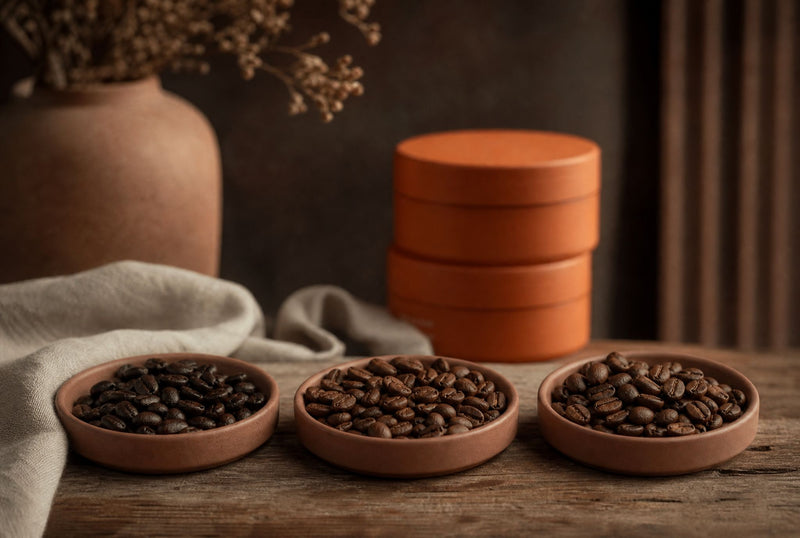
Specialty coffee has a vocabulary of its own, and most of it is plain once written down. Specialty is a grade, not a mood. Single origin is a claim about traceability. Process describes what happened to the fruit after picking. Eighteen terms below, in the order you tend to meet them.
Definitions, not opinions. Where a term is used loosely in the trade, that is said.
Grade and quality
Specialty. A grade, not a style. Coffee that scores 80 points or above on the Specialty Coffee Association's 100-point cupping protocol, judged clean, distinct and free of defects. Most specialty coffee sits between 84 and 89.
Third wave. The movement, roughly from the early 2000s, that treats coffee as an agricultural product with an origin worth naming rather than a commodity. Lighter roasting, named farms, published recipes, and a scale to argue over.
Cupping. The standard method for assessing coffee. Ground coffee is steeped in hot water, the crust broken and skimmed, the liquid slurped from a spoon. Same grind, ratio and water for every sample on the table.
SCA score. The number a cupping produces under the Specialty Coffee Association protocol, out of 100, covering aroma, flavour, acidity, body, balance and defects. Eighty is the specialty threshold. Above 90 is rare.
Origin and traceability
Where a coffee came from, and how much of that can be checked. The long form is in what single origin means.
Single origin. Coffee from one identified place rather than a blend. The strict version means one farm, one lot, one harvest. The loose version means one country, which can pool hundreds of farms.
Lot. One defined quantity of coffee kept separate from picking through processing to export. The lot is what makes a cupping score or a laboratory result mean anything, because it points at a specific coffee.
Cultivar. A cultivated variety of the coffee plant, selected and propagated for traits such as yield, disease resistance or flavour. Gesha, Bourbon, Typica, Caturra. The cultivar sets the ceiling for a cup.
Traceability. The chain of custody from farm to bag: who grew it, which lot, which harvest, who exported it, who roasted it and on what date. Traceability is what allows a claim to be checked.
Processing and freshness
What happens to the fruit after picking, and to the seed after roasting. Process is covered at length in washed, natural, honey.
Process. What happens to the coffee fruit after picking, and how the seed is separated from it. The three common routes are washed, natural and honey. Process shapes the cup about as much as origin does.
Anaerobic. Fermentation in a sealed vessel with the oxygen excluded, usually for a set number of hours. It changes which acids and aromatic compounds form, giving ferment and fruit notes the same coffee would not otherwise show.
Honey. A process between washed and natural. The skin is removed and some of the sticky fruit mucilage is left on the seed as it dries. Named for the texture of that layer, not for any honey flavour.
Roast date. The day the coffee was roasted, printed on the bag. Not a best before date, which is a shelf-life estimate set by the seller. Roast date is the only freshness information that means anything.
Organic, safety and testing
Four terms that get used loosely and are worth holding precisely. The long form is in what organic specialty coffee is.
Organic. A farming standard. Grown without synthetic pesticides or fertilisers, audited where certified. Organic governs how a coffee was grown, not how it tastes and not what it picked up in storage after harvest.
Organic by practice. Grown by organic methods, without synthetic inputs, but without the certificate. Common among smallholders for whom certification costs more in fees and years than the farm can carry. Honest labelling states which it is.
Mycotoxin. A toxic compound produced by certain moulds. In coffee the two of interest are ochratoxin A and the aflatoxins, which form when green coffee dries too slowly or sits damp. Only testing reveals them.
ISO 17025. The international standard for the competence of testing laboratories. Accreditation is granted method by method by a national body, and reassessed on a cycle. It describes the laboratory, not the coffee.
Species and place
Two words carrying more history than the rest put together. Both are set out in the three-species comparison.
Liberica. The third commercial coffee species, after arabica and robusta, at under one per cent of world supply. Large uneven beans, heavy body, low register. The Specialty Coffee Association recognised it in April 2022.
Kopi. Southeast Asian coffee in its traditional form, usually Liberica or robusta roasted dark with sugar and margarine, then brewed through a cloth sock. A method and a culture, distinct from specialty roasting.
Eighteen words. The six coffees they describe are here.
The short answers
What does specialty coffee mean?
A grade. Coffee scoring 80 points or above on the Specialty Coffee Association's 100-point cupping protocol, judged clean, distinct and free of defects. It describes measured quality, not a style of cafe.
What is the difference between single origin and blend?
A single origin comes from one identified place, at its strictest one farm, one lot, one harvest. A blend mixes coffees, usually for consistency or for espresso, and its traceability is looser.
What does organic mean on a coffee bag?
That the coffee was grown without synthetic pesticides or fertilisers. Certified organic means an auditor checked. Organic by practice means the methods are followed without the certificate, which many smallholders cannot afford.
What is Liberica coffee?
The third commercial coffee species, at under one per cent of world supply, grown mainly in Malaysia, the Philippines and Indonesia. Heavier in body than arabica, and about half its caffeine.